Understanding Sideways Spinal Curvature
Scoliosis is a condition in which the spine curves sideways, often forming an S or C shape rather than running in a straight vertical line.
It most commonly develops during childhood and adolescent growth spurts, though it can also occur in adults, and ranges widely in severity from mild curves requiring only monitoring to more significant curves needing bracing or surgical correction.
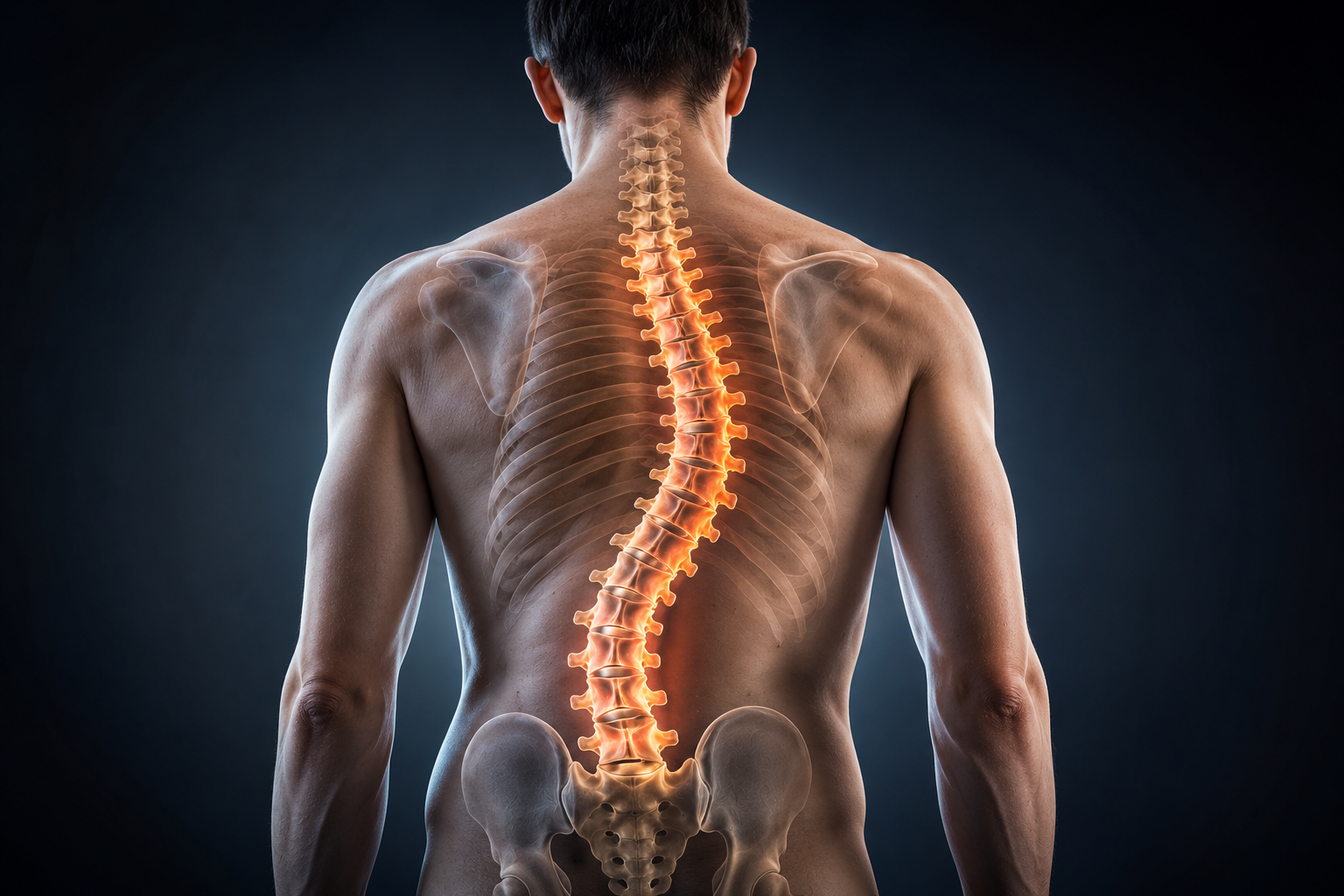
Types of Scoliosis
- Idiopathic scoliosis: The most common type, with no clearly identified cause, typically developing during adolescence
- Congenital scoliosis: Present from birth due to abnormal spinal vertebral development
- Neuromuscular scoliosis: Associated with underlying neurological or muscular conditions
- Degenerative scoliosis: Developing in adulthood from age-related spinal wear
Symptoms
- Visibly uneven shoulders or waistline
- One shoulder blade appearing more prominent than the other
- Leaning of the upper body to one side
- In more significant curves, back pain and, rarely, breathing difficulty
Diagnosis
Diagnosis involves a physical examination, including the forward bend test, combined with X-ray imaging to measure the exact degree of curvature (Cobb angle), which helps determine the severity and guide treatment decisions.
Treatment Options
- Observation and monitoring for mild curves, particularly in growing children
- Bracing for moderate curves in growing adolescents to prevent progression
- Physiotherapy-based scoliosis-specific exercise programs to support spinal alignment and function
- Surgical correction considered for severe or rapidly progressing curves
Frequently Asked Questions
Is scoliosis painful?
Many cases, particularly in adolescents, are not significantly painful, though larger curves or degenerative adult scoliosis can be associated with back discomfort.
Can scoliosis be corrected with exercise alone?
Scoliosis-specific exercise programs can help manage symptoms and, in some cases, curve progression, though significant structural curves often require bracing or surgery for correction.
Does scoliosis get worse with age?
Curve progression varies; some curves, especially in growing children, can worsen without treatment, while degenerative adult scoliosis may slowly progress with age-related spinal wear.
Take Care of Your Spinal Health
Concerned about back, neck, or spine pain? Book a consultation today with our specialists.
Book Spine Specialist Consultation