Understanding Spinal Slippage
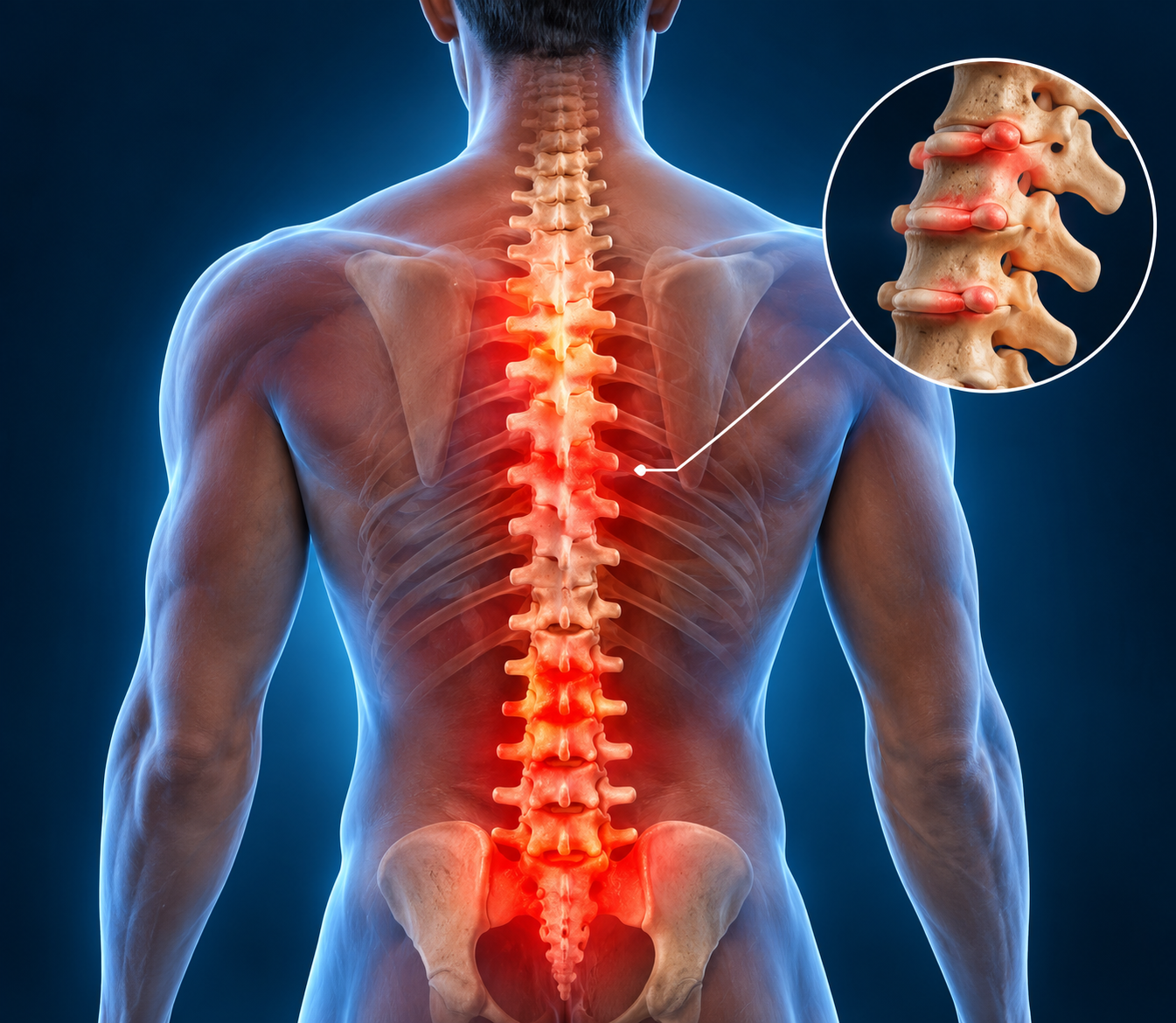
Spondylolisthesis occurs when one vertebra slips forward relative to the bone beneath it, most commonly in the lower back.
This slippage can range from mild and asymptomatic to significant enough to cause pain and nerve compression, and understanding its grade and underlying cause is important for guiding the right treatment approach.
Types and Causes
- Degenerative spondylolisthesis — related to age-related wear of the spinal joints, most common in older adults
- Isthmic spondylolisthesis — caused by a small stress fracture in a spinal bone, often linked to sports involving repeated back extension
- Congenital spondylolisthesis — present from birth due to abnormal spinal development
- Traumatic spondylolisthesis — resulting from significant injury
Grading the Slip
Spondylolisthesis is graded from 1 to 4 based on the percentage of forward slippage, with Grade 1 representing mild slippage and Grade 4 representing severe displacement.
Higher grades are more likely to cause significant symptoms and may influence treatment decisions, including whether surgery is considered.
Symptoms
- Lower back pain that may worsen with standing or extension movements
- Tight hamstring muscles, a common associated finding
- Leg pain, numbness, or tingling if a nerve root becomes compressed
- In more severe cases, changes in posture or gait
Treatment Options
- Physiotherapy focused on core stabilization and flexion-based exercises
- Activity modification to reduce aggravating extension-based movements
- Bracing in select cases, particularly for adolescent isthmic spondylolisthesis
- Surgical stabilization considered for higher-grade slips or significant, unresponsive nerve symptoms
Frequently Asked Questions
Is spondylolisthesis serious?
Many cases, particularly lower-grade slips, are manageable with conservative treatment, while higher-grade or progressively worsening slips may require closer monitoring or surgical evaluation.
Can spondylolisthesis heal on its own?
The vertebral slip itself does not reverse, but symptoms often improve significantly with targeted physiotherapy and activity modification.
What activities should be avoided with spondylolisthesis?
Activities involving repetitive back extension or heavy loading, such as certain gymnastics or weightlifting movements, are often modified during symptomatic periods.
Take Care of Your Spinal Health
Concerned about back, neck, or spine pain? Book a consultation today with our specialists.
Book Spine Specialist Consultation