Understanding Rounded Upper Back
Kyphosis refers to an excessive forward curvature of the upper spine, giving the back a rounded or hunched appearance. While a mild, natural curve in the thoracic spine is normal, an exaggerated curve can lead to stiffness, pain, breathing difficulty, and reduced mobility over time.
Kyphosis can develop gradually from posture-related habits or, in some cases, from structural changes in the spine such as vertebral compression or developmental conditions. Recognizing the type and cause of kyphosis early makes a significant difference in how effectively it can be managed.
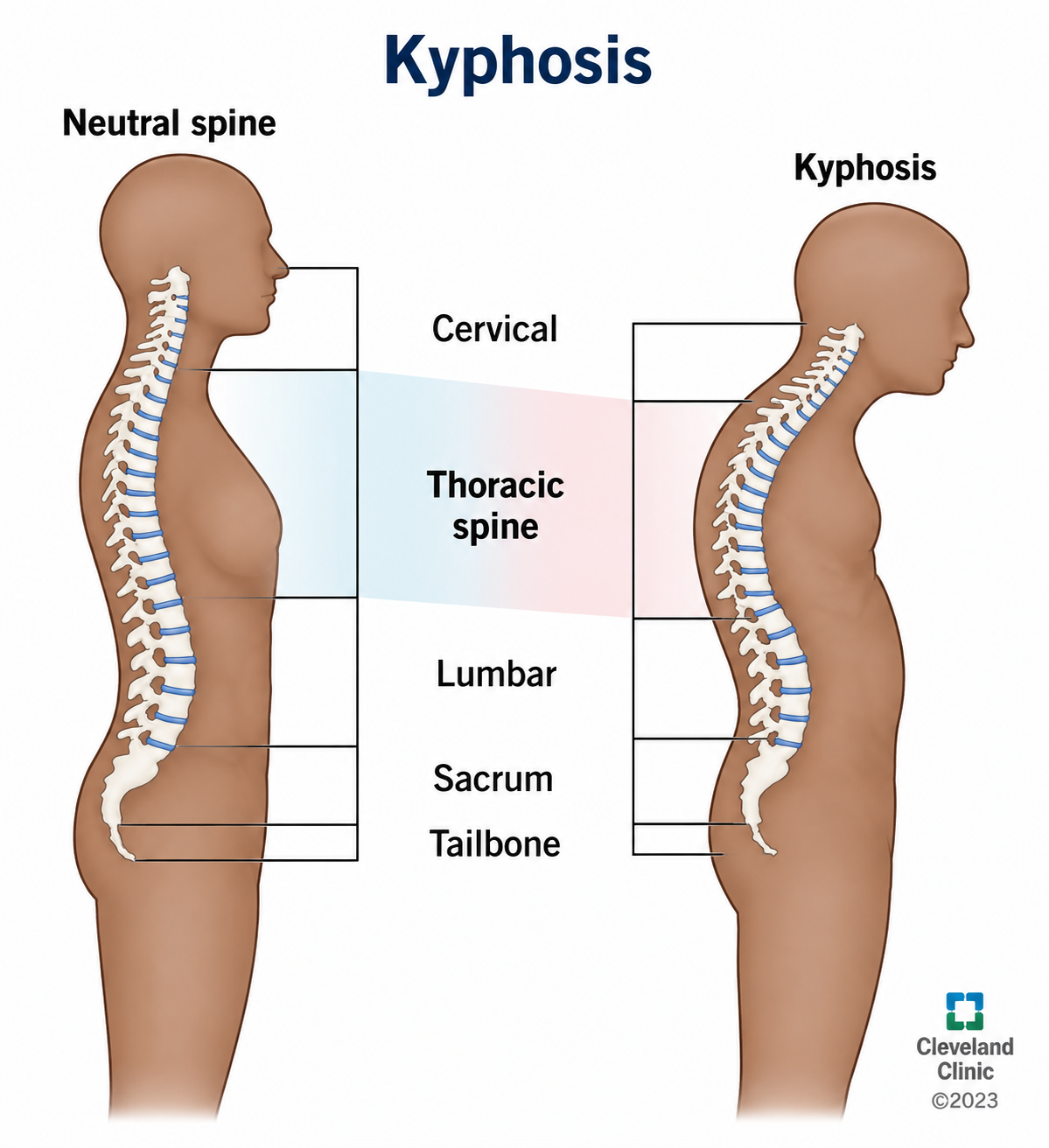
Types of Kyphosis
- Postural kyphosis — the most common type, caused by slouching habits and weak postural muscles; usually flexible and correctable.
- Scheuermann's kyphosis — a structural, rigid curve that develops during adolescent growth spurts due to wedge-shaped vertebrae.
- Age-related kyphosis — associated with degenerative disc changes and vertebral compression fractures, often linked to osteoporosis.
- Congenital kyphosis — present from birth due to abnormal spinal development.
Common Symptoms
- Visibly rounded or hunched upper back
- Upper back stiffness and fatigue, especially after prolonged sitting or standing
- Mild to moderate back pain that worsens with activity
- Tight chest and shoulder muscles with weak upper back muscles
- In advanced cases, reduced lung capacity and difficulty with deep breathing
What Causes an Increased Thoracic Curve?
- Prolonged slouched sitting, especially with screens and mobile devices
- Weak core and scapular stabilizing muscles
- Osteoporosis-related vertebral compression fractures in older adults
- Structural growth abnormalities such as Scheuermann's disease
- Degenerative disc disease and age-related spinal changes
How Kyphosis Is Diagnosed
Diagnosis typically starts with a visual postural assessment and a forward bend test to check whether the curve is flexible or rigid.
X-rays measure the exact degree of thoracic curvature, helping distinguish postural kyphosis from more structural forms.
In adults, bone density scans may be recommended if osteoporosis is suspected as an underlying contributor.
Treatment and Correction Strategies
- Postural retraining exercises to strengthen the mid-back and scapular stabilizers
- Chest and shoulder stretching to release tightness pulling the shoulders forward
- Core strengthening to support overall spinal alignment
- Ergonomic changes to workstations to reduce prolonged forward-head, rounded-shoulder posture
- Bracing in select adolescent cases with progressive structural curves
- Bone health management, including calcium, vitamin D, and weight-bearing exercise, for age-related kyphosis
Exercises That Help
- Wall angels and scapular retraction drills
- Thoracic extension over a foam roller
- Prone back extensions (cobra-style stretches)
- Chest-opening doorway stretches
- Rowing-pattern resistance exercises to strengthen the upper back
Frequently Asked Questions
Can kyphosis be reversed with exercise?
Postural kyphosis often improves significantly with consistent strengthening and stretching exercises. Structural kyphosis, such as Scheuermann's, can be partially improved but may not fully reverse without more targeted intervention.
At what age does kyphosis usually appear?
Postural kyphosis can develop at any age from habitual slouching. Scheuermann's kyphosis typically appears during the adolescent growth spurt, while age-related kyphosis is more common after 60.
Is kyphosis the same as a hunchback?
"Hunchback" is a colloquial term often used to describe visible kyphosis, but true kyphosis exists on a spectrum from mild rounding to a significant structural curve requiring medical care.
Does kyphosis affect breathing?
In moderate to severe cases, an exaggerated thoracic curve can reduce chest wall expansion and limit lung capacity, making deep breathing feel more restricted.
When Kyphosis Needs Specialist Attention
Most postural kyphosis responds well to guided exercise and ergonomic changes. However, a rigid curve that doesn't correct with active extension, progressive worsening in adolescents, or new back pain in older adults with a known compression fracture should be evaluated by a spine specialist for further imaging and a tailored management plan.
Concerned about chest, rib, or upper back pain? Book a consultation today with our specialists.
Book Spine Specialist Consultation