Neck Pain with Hand Pain: Causes, Symptoms & Treatment
A specialized medical guide to understanding cervical radiculopathy, nerve root compression, diagnostic evaluation pathways, and conservative versus surgical care options.
Book Free Consultation
Enter your details and our senior medical coordinator will reach out.
Why Does Neck Pain Spread to the Hand?
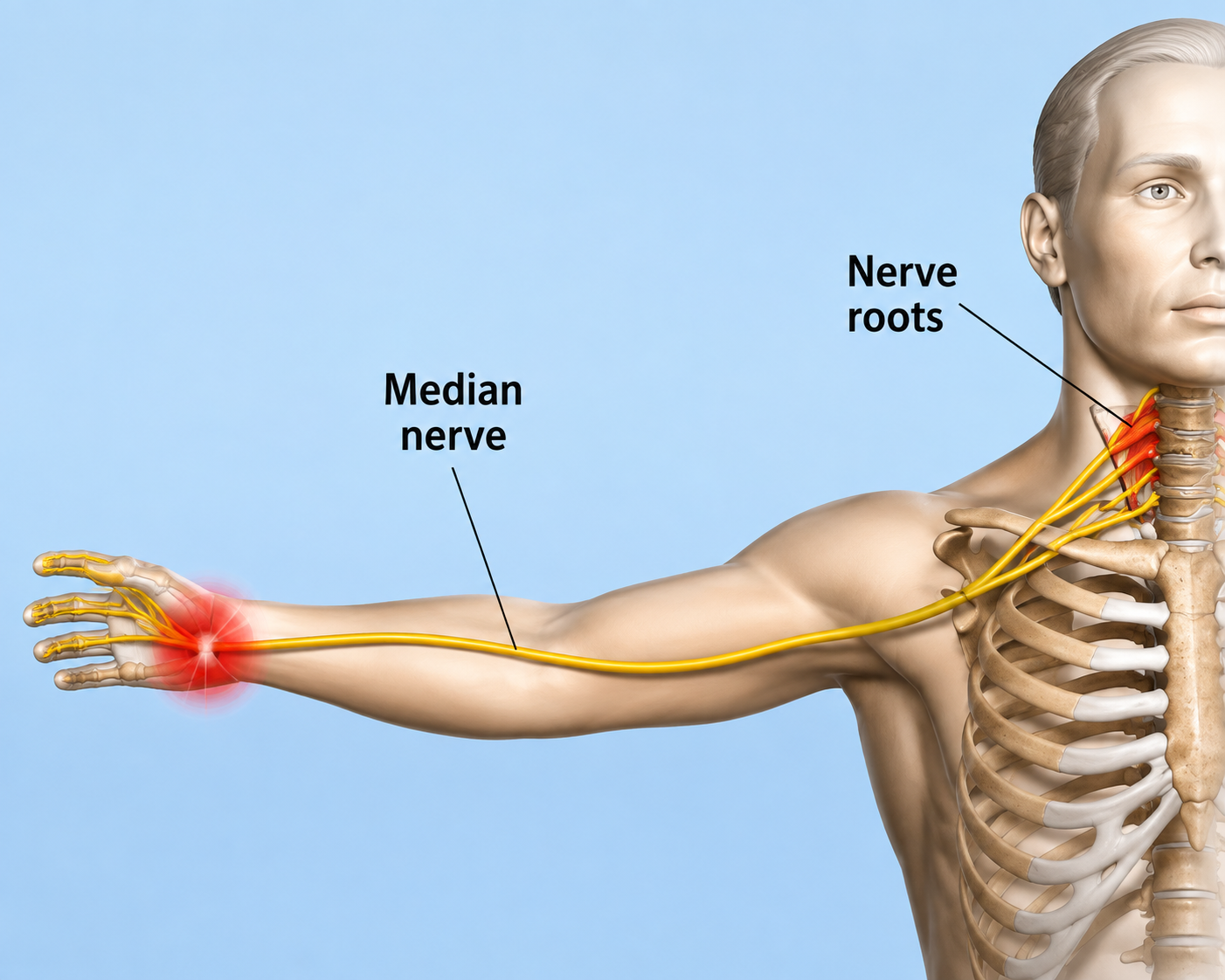
When neck pain travels into the hand, it usually points to cervical nerve root involvement rather than a simple muscular strain or isolated wrist condition.
The complex neural network supplying sensation and motor control to the arms and hands originates directly in the cervical spine. Therefore, disc herniation, bone spurs, or foraminal stenosis at the neck can send shooting pain, numbness, tingling, or weakness all the way down to the fingers — a clinical pattern known as cervical radiculopathy.
Common Symptoms of Neck & Hand Pain
Do not ignore these physical red flags associated with cervical radiculopathy and nerve root impingement:
Radiating Arm Pain
Neck discomfort accompanied by sharp or burning pain radiating into the shoulder, arm, and hand.
Finger Paresthesia
Tingling or a pins-and-needles sensation localized in specific fingers depending on the pinched nerve level.
Forearm & Hand Numbness
Loss of sensation or numbness affecting discrete areas of the hand or forearm.
Grip Weakness & Shock
Reduced grip strength, difficulty holding objects, or an electric-shock-like sensation running down the arm.

What Causes Neck Pain with Hand Pain?
Cervical nerve root compression arises from disc herniations, foraminal stenosis, and spinal wear:
- Cervical Disc Herniation: A bulging or prolapsed disc pressing directly against an exiting nerve root.
- Cervical Spondylosis: Age-related arthritis narrowing the neural foramina where nerves exit the spine.
- Cervical Spinal Stenosis: Narrowing of the central spinal canal affecting cord and nerve pathways.
- Postural & Thoracic Outlet Strain: Forward head posture and neurovascular compression near the collarbone.
Treatment Strategy & Nerve Decompression
Managing cervical radiculopathy centers on physical therapy, cervical traction, and targeted anti-inflammatory care:
Conservative Therapy & Traction
Physiotherapy for nerve gliding, cervical traction to widen neural foramina, postural correction, and anti-inflammatory medication.
Injections & Surgery
Targeted cervical epidural steroid injections for acute nerve inflammation, and surgical decompression for progressive hand weakness.
How Neck & Hand Pain Is Diagnosed
Our structured 4-tier clinical diagnostic protocol evaluates C5-T1 dermatomes, Spurling's provocation, ULTT neural tension tests, and 3T MRI nerve root compression mapping.
1. History & Finger Numbness Audit
Detailed screening of specific finger numbness patterns, grip strength loss, neck position triggers, and onset.
- Specific Finger Numbness Mapping: Identifying exact fingers affected (thumb/index = C6, middle = C7, ring/pinky = C8).
- Grip Strength & Dropping Objects: Inquiring about clumsiness, dropping cups, or difficulty opening jars.
- Electric-Shock Arm Radiation: Tracking sharp, lightning-like pain shooting down the arm into the hand.
- Neck Position Trigger Audit: Recording arm pain worsening when turning or tilting head toward the painful side.
- Bakody's Sign (Abduction Relief): Noting if placing hand on top of head relieves shooting arm pain.
- Prior Neck Injury / Whiplash: Screening history of rear-end car collisions or sports trauma.
- Night Sleep Disruption: Evaluating nocturnal arm throbbing and hand paresthesia waking patient.
- Carpal Tunnel Syndrome Differentiation: Ruling out isolated median nerve wrist compression vs cervical radiculopathy.
- Occupational Vibrating Tool Audit: Checking work exposure involving hand-arm vibration syndrome.
- Medication Efficacy Review: Documenting response to neuropathic agents (gabapentin) or NSAIDs.
- Visual Analog Scale (VAS) Baseline: Recording neck and hand pain scores (0-10 scale).
- Baseline Neck Disability Index (NDI): Measuring functional impairment across daily living activities.
2. Radiculopathy & Myelopathy Screen
Evaluating cervical nerve root compression, double crush syndromes, and upper motor neuron myelopathy.
- C5 Nerve Root Compression: Deltoid weakness and lateral shoulder numbness.
- C6 Nerve Root Compression: Biceps reflex loss, thumb/index numbness, and wrist extension weakness.
- C7 Nerve Root Compression: Triceps reflex loss, middle finger numbness, and elbow extension weakness.
- C8-T1 Nerve Root Compression: Intrinsic hand muscle wasting, ring/pinky numbness, and finger abduction weakness.
- Double Crush Syndrome: Identifying concurrent cervical nerve root pinch and peripheral nerve entrapment (carpal/cubital tunnel).
- Thoracic Outlet Syndrome (TOS) Check: Rule-out for brachial plexus compression near first rib.
- Hoffmann’s Reflex Sign: Flicking middle finger nail checking reflexive thumb flexion (myelopathy sign).
- 10-Second Grip & Release Test: Fine motor dexterity timing (<20 opens/closes indicates spinal cord compression).
- Tandem Gait & Romberg Test: Evaluating balance and proprioception for spinal cord compromise.
- Emergency Myelopathy Triage: Immediate surgical consultation protocol for progressive hand weakness or gait loss.
3. Physical Exam & Neural Tension Tests
Spurling's test, Upper Limb Tension Tests (ULTT 1-4), Tinel's wrist/elbow checks, and reflex grading.
- Spurling’s Maneuver: Neck extension, side-bending, and axial compression reproducing arm radicular pain.
- Upper Limb Tension Test (ULTT 1 / Median Nerve): Sequential shoulder/elbow/wrist positioning reproducing arm symptoms.
- Cervical Distraction Test: Manual upward traction relieving foraminal nerve root pressure.
- Tinel’s Sign at Wrist & Elbow: Percussing median and ulnar nerves to rule out peripheral entrapment.
- Phalen’s Test for Carpal Tunnel: Flexing wrists to check for hand numbness duplication.
- Deep Tendon Reflex Grading (0-4+): Testing Biceps, Brachioradialis, and Triceps reflex symmetry.
- Myotomal Motor Power Testing (0-5 Scale): Evaluating key muscle groups across C5 to T1.
- Cervical Range of Motion Goniometry: Measuring active rotation, flexion, and extension limits.
- Shoulder & Elbow Joint Screening: Ruling out intrinsic shoulder bursitis or tendonitis.
- Physical Baseline Record: Documenting reflex grades, grip strength (dynamometer), and NDI scores.
4. 3T MRI, NCS & Care Roadmap
High-resolution 3T cervical MRI, electromyography (EMG/NCS), epidural steroid injections, and surgical discectomy.
- High-Resolution 3T Cervical Spine MRI: Gold standard imaging evaluating disc herniations, foraminal stenosis, and nerve root compression.
- Electromyography & Nerve Conduction Studies (EMG/NCS): Differentiating cervical radiculopathy from peripheral nerve entrapments (carpal/cubital tunnel).
- Cervical Spine X-Rays (AP, Lateral & Oblique): Visualizing bone spurs, uncovertebral arthrosis, and foraminal narrowing.
- Clinical-Radiological Correlation Check: Correlating MRI findings with patient's precise dermatomal numbness map.
- Targeted Physiotherapy Protocol: Prescribing cervical traction, nerve glides, deep neck flexor strengthening, and posture training.
- Cervical Epidural Steroid Injections (ESI): Fluoroscopically guided anti-inflammatory delivery for acute radicular arm pain.
- Ergonomic & Workstation Prescription: Adjusting monitor height and keyboard placement to eliminate cervical flexion strain.
- Surgical Decompression Triage (ACDF): Anterior cervical discectomy and fusion for progressive motor weakness or failed conservative care.
- Multi-Specialist Spine Panel: Collaborative spine surgeon, neurologist, and physical therapist case review.
- Digital Archiving: Secure cloud storage of cervical MRI DICOM files and EMG reports in patient portal.
- Final Clinical Clearance: Approving independent lifelong ergonomic posture and hand strengthening routines.
Meet Our Cervical Nerve Experts
Our team focuses on assessing neck pain that radiates into the arm or hand, understanding possible cervical nerve irritation, improving comfortable movement, and supporting arm and hand function through an individualised assessment and rehabilitation plan.
Ask Our Specialist
Neck pain that spreads into the arm or hand may be associated with cervical nerve irritation or compression. Symptoms can include radiating pain, tingling, numbness, or grip weakness. Our approach focuses on clinical assessment, suitable treatment options, gradual mobility and strength building, and an individualised care plan tailored to your needs and recovery goals.
Patient Success Stories
Watch real recovery stories from patients who regained their active lifestyles.
Patient Recovery Story
Real experiences. Better mobility.
Patient Recovery Story
Real patient experiences and recovery journeys.
Frequently Asked Questions
Clear answers to common clinical questions about neck pain spreading to the hand and treatment.