Understanding TFCC Strain
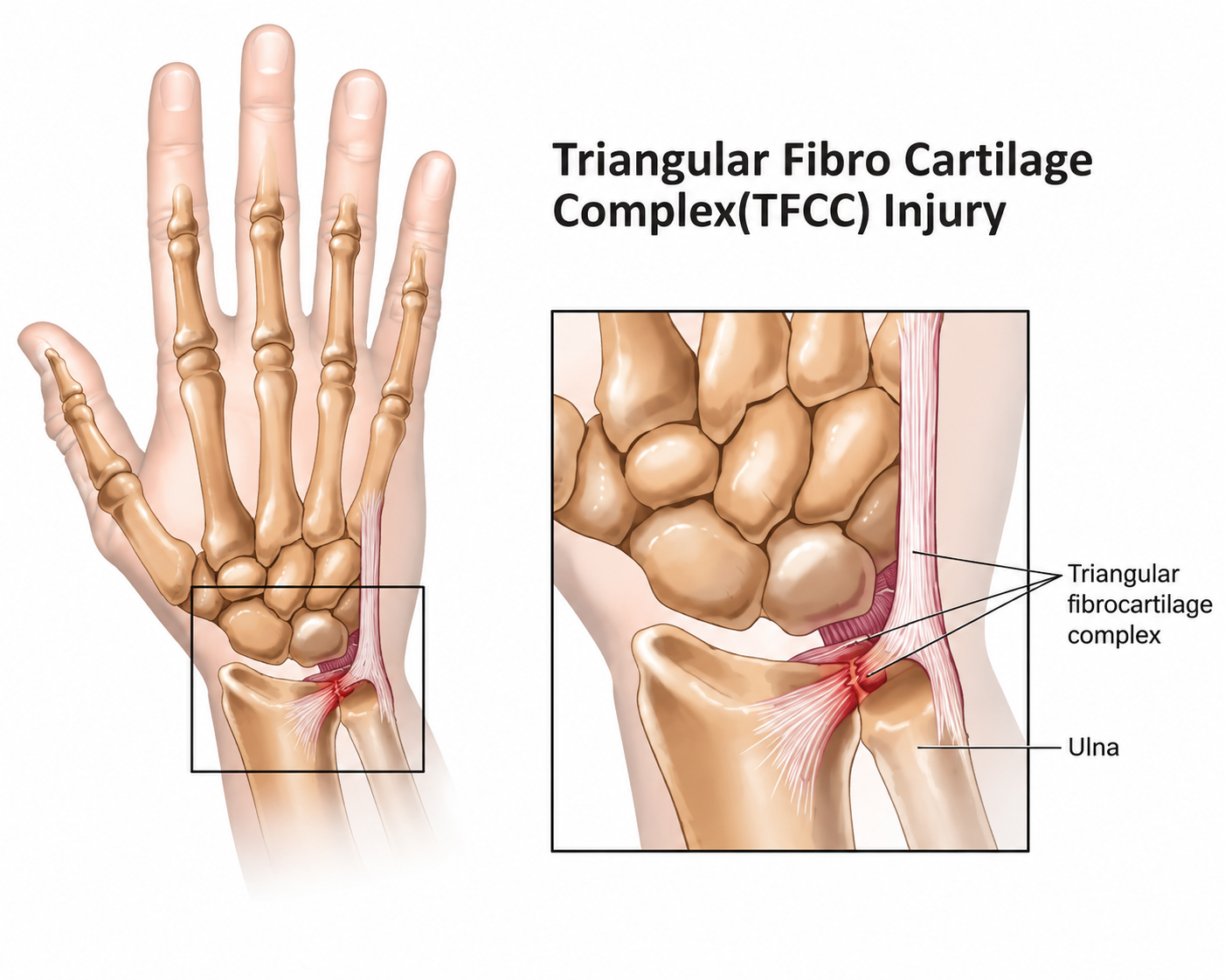
The triangular fibrocartilage complex, or TFCC, is a small but essential cushion of cartilage and ligaments on the pinky side of the wrist that supports weight-bearing and rotational movement.
A TFCC strain can cause persistent wrist pain that's easy to overlook, since it often doesn't show up on standard X-rays.
Our clinic offers focused diagnosis and treatment for TFCC strain to relieve pain and restore stable wrist function.
What Is the TFCC and Why It Gets Strained
The TFCC acts as a shock absorber between the two forearm bones and the small wrist bones, stabilizing the joint during activities like gripping, pushing, or rotating the forearm.
Because it bears significant load during these movements, it can become strained or torn from a single traumatic event or from repetitive stress over time.
Common Causes of TFCC Strain
A fall onto an outstretched, twisted hand
Repetitive gripping or rotating movements, such as in racquet sports or manual work
Sudden forceful twisting of the wrist
Age-related degeneration of the cartilage, even without a specific injury
Symptoms of TFCC Strain
- Pain on the pinky side of the wrist, especially with gripping or twisting
- A clicking or catching sensation during wrist rotation
- Weakness when bearing weight through the wrist, such as pushing up from a chair
- Swelling localized to the outer edge of the wrist
Treatment Options for TFCC Strain
Targeted recovery plans focus on cartilage protection and joint stabilization:
- Splinting or bracing – limits rotation to allow the cartilage to heal
- Activity modification – avoids movements that provoke pain
- Physiotherapy – restores strength and stability around the wrist
- Corticosteroid injection – reduces inflammation in persistent cases
- Arthroscopic repair – considered for significant tears that don't respond to conservative care
Frequently Asked Questions
Does a TFCC strain show up on an X-ray?
Not usually; X-rays are mainly used to rule out fractures, while an MRI or wrist arthroscopy is typically needed to confirm a TFCC injury.
Can a TFCC strain heal without surgery?
Yes, many strains and smaller tears improve with splinting, activity changes, and physiotherapy, with surgery reserved for more significant or persistent tears.
What activities tend to aggravate TFCC strain?
Gripping, twisting the forearm, and bearing weight through the wrist, such as pushing up from a seated position, commonly worsen symptoms.
Concerned about wrist or hand pain? Book a consultation today with our specialists.
Book Wrist Specialist Consultation