Understanding Rotator Cuff Disorders
The rotator cuff is a group of four muscles and their tendons that surround the shoulder joint, providing both movement and stability.
Because these structures work continuously during arm activity, they're prone to a wide spectrum of disorders, from mild inflammation to full tears. Our clinic offers complete evaluation and treatment for rotator cuff disorders, tailored to the severity and nature of the condition.
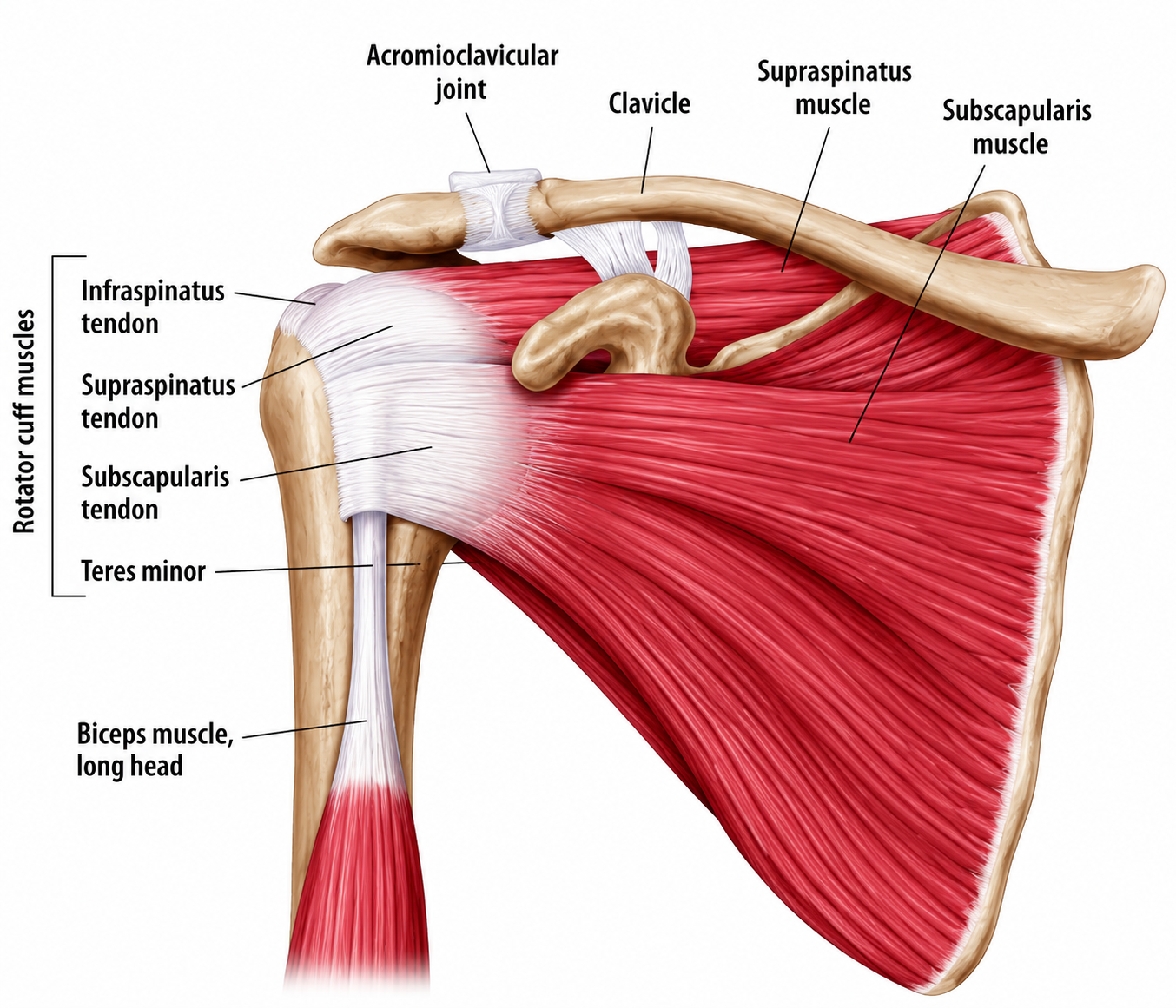
What Makes Up the Rotator Cuff?
The rotator cuff consists of the supraspinatus, infraspinatus, subscapularis, and teres minor muscles, along with their tendons, which work together to lift, rotate, and stabilize the shoulder. Because these tendons converge in a relatively confined space, they're collectively vulnerable to overuse, impingement, and age-related degeneration.
Spectrum of Rotator Cuff Disorders
- Tendinitis: inflammation without structural tearing
- Partial tears: incomplete damage to tendon fibers
- Full-thickness tears: complete separation of the tendon from bone
- Rotator cuff impingement: compression of tendons during shoulder movement
- Bicipital tendinitis and instability: related biceps tendon involvement
Signs of a Rotator Cuff Problem
- Pain with overhead reaching or lifting
- Weakness when raising or rotating the arm
- Night pain, particularly when lying on the affected side
- A cracking or popping sensation during shoulder movement
Treatment Approaches for Rotator Cuff Disorders
- Physiotherapy: the first-line approach for most rotator cuff conditions
- Anti-inflammatory treatment: controls pain during active phases
- Corticosteroid or PRP injections: targeted relief for persistent inflammation
- Arthroscopic rotator cuff repair: considered for significant tears not responding to conservative care
Frequently Asked Questions
Can a rotator cuff tear heal without surgery?
Small partial tears can sometimes improve with physiotherapy and activity modification, while larger or full-thickness tears often require surgical repair for full function.
How do I know if I have a rotator cuff tear versus tendinitis?
A physical exam combined with imaging like ultrasound or MRI is usually needed to distinguish between inflammation and an actual structural tear.
Is rotator cuff surgery a major procedure?
Most rotator cuff repairs today are done arthroscopically, a minimally invasive technique with a generally shorter recovery than traditional open surgery.
Take Care of Your Health
Concerned about shoulder pain or looking for a diagnosis? Book a consultation today with our specialists.
Book Specialist Consultation