Understanding Osgood-Schlatter Disease
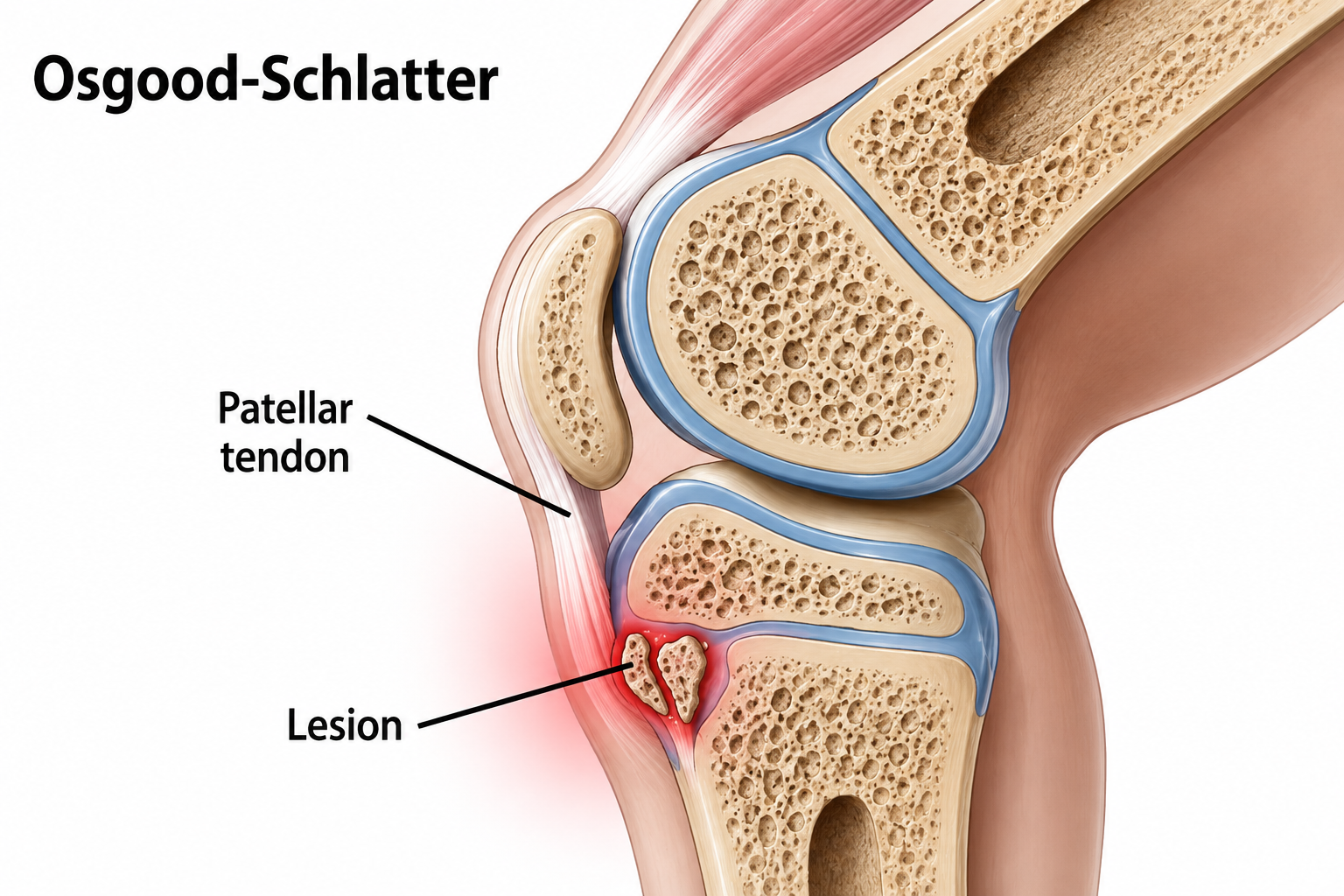
Osgood-Schlatter disease is a common cause of knee pain in growing adolescents, resulting from repetitive traction stress on the growth plate at the top of the shinbone, just below the kneecap, where the patellar tendon attaches.
It typically occurs during growth spurts in physically active children and, while it can be uncomfortable, is a self-limiting condition that resolves as the growth plate matures and fuses.
Why Osgood-Schlatter Disease Occurs
During the adolescent growth spurt, the growth plate at the top of the shinbone is a relatively weak point compared to the strong pull of the patellar tendon during running and jumping activities. Repetitive traction from this tendon pull can irritate and, in some cases, cause small amounts of bony fragmentation at this growth plate, leading to the characteristic pain and bump seen in this condition.
Who Is Most Affected?
- Active adolescents: Typically boys aged 12–15 and girls aged 10–13
- Sports participants: Children involved in running, jumping, or kicking sports such as football, basketball, and athletics
- Rapid growth: Those experiencing a rapid growth spurt combined with high sports participation
Symptoms
- Pain and localized tenderness just below the kneecap, over the shinbone prominence
- A visible or palpable bony bump at the tibial tuberosity
- Pain that consistently worsens with running, jumping, or kneeling
- Symptoms that typically ease with rest and flare up again with return to activity
Diagnosis
Osgood-Schlatter disease is usually diagnosed clinically based on the characteristic location of pain and swelling in an actively growing adolescent.
X-rays are occasionally utilized to confirm findings or rule out other differential causes of adolescent knee pain when presentation is atypical.
Treatment and Management Approaches
- Activity modification: Reducing training volume to control symptoms during flare-ups without requiring complete cessation of sport
- Ice application: Applying cold packs after activity to manage discomfort and inflammation
- Flexibility training: Dedicated quadriceps and hamstring stretching to reduce pulling tension on the growth plate
- Gradual progression: A stepped return to full sporting activity as symptoms subside
- Reassurance: Educating the patient and family that the condition is self-limiting and resolves upon growth plate closure
Frequently Asked Questions
Does Osgood-Schlatter disease go away on its own?
Yes, in the vast majority of cases, symptoms resolve completely once the growth plate fully matures and fuses, typically by the late teenage years.
Should my child stop playing sports with Osgood-Schlatter disease?
Complete cessation is rarely necessary; activity is typically modified based on symptom severity rather than stopped altogether, allowing continued participation where well-tolerated.
Will the bony bump below the knee go away?
The bony prominence may persist to some degree into adulthood even after pain completely resolves, though it is generally not a functional problem at that stage.
Take Care of Your Child's Knee Health
Concerned about adolescent knee pain or looking for a specialist evaluation? Book a consultation today with our experts.
Book Knee Specialist Consultation